Advanced Propulsion & Engineering

Aviation Propulsion Insights & Engineering Blog

Technical deep-dives, environmental test benchmarks, and sizing guides for electric ducted fans (EDF) and eVTOL platforms.

Flying Cars 2026: What Is Real, What Is Hype, and What Comes NextIndustry Analysis & Tech Review
•11 min technical analysis

Flying Cars 2026: What Is Real, What Is Hype, and What Comes Next

On October 15, 2026, Tesla demonstrated its next-generation Roadster flipping in mid-air and using underbody fans, reigniting the "flying car" frenzy. But where does the low-altitude vehicle sector truly stand in 2026? This authoritative aerospace review dissects roadable cars vs passenger eVTOL air taxis, tracks civil aviation type certification progress across FAA, CAAC and EASA, and analyzes why distributed ducted fan propulsion is central to urban acoustic compliance and blade containment safety.
What Is Disk Loading? Actuator Disk Momentum Theory, Hover Power & eVTOL Ducted Fan SizingAerodynamic Theory & Sizing
•12 min technical read

What Is Disk Loading? Actuator Disk Momentum Theory, Hover Power & eVTOL Ducted Fan Sizing

In rotorcraft, eVTOL, and drone propulsion design, disk loading (DL = T/A) governs the fundamental trade-off between vertical hover efficiency and forward cruise packaging. While classic momentum theory demonstrates that hover power scales with the square root of disk loading, modern distributed electric ducted fans (DEP) exploit shroud lip suction and tip vortex suppression to achieve compact vertiport footprints without prohibitive hovering energy penalties.

Archer Midnight vs. Joby S4 vs. Ducted Fan eVTOL: Architectural, Safety, and Acoustic Benchmark (2026)eVTOL Architecture & Benchmark
•15 min engineering analysis

Archer Midnight vs. Joby S4 vs. Ducted Fan eVTOL: Architectural, Safety, and Acoustic Benchmark (2026)

As urban air mobility approaches commercial airworthiness certification, three distinct electric propulsion philosophies have emerged: Archer Midnight’s 12-rotor hybrid tilt-forward configuration, Joby S4’s 6 large tilting open rotors, and distributed electric ducted fan (DEP) architectures. This technical review objectively evaluates these configurations across aerodynamic disk loading, rooftop vertiport operational footprint, ground passenger safety, blade containment, and 100-meter sideline acoustic signatures.

The Largest Electric Ducted Fans in the World (2026): From 90mm RC Models to 1000 kgf Megawatt Aviation ThrustersAviation Technology Review
•13 min technical read

The Largest Electric Ducted Fans in the World (2026): From 90mm RC Models to 1000 kgf Megawatt Aviation Thrusters

Electric ducted fans have moved far beyond hobby remote-control aircraft. Today, aviation-grade units have crossed the megawatt barrier, generating up to 1000 kgf (9,800 N) of static thrust. This aerospace review explores the physical scaling laws of ducted propulsors, the extreme structural challenges of large-diameter carbon shrouds, and how modern 800V SiC high-voltage powertrains make 1.6-meter industrial ducted fans commercially viable for heavy eVTOLs and cargo aircraft.

Ducted Fan Quadcopters for Industrial UAVs: Benefits, Limits & SizingIndustrial UAV Engineering Guide
•11 min engineering guide

Ducted Fan Quadcopters for Industrial UAVs: Benefits, Limits & Sizing

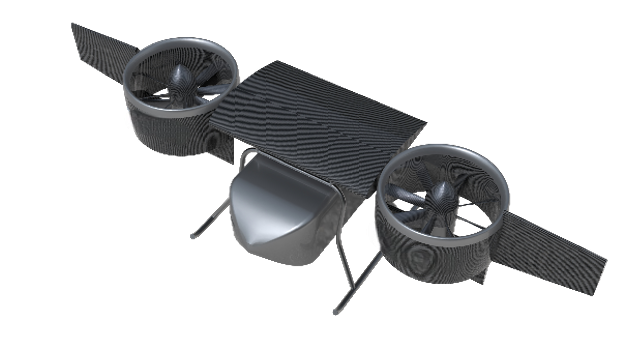
A ducted fan quadcopter places each rotor inside a load-bearing shroud. The architecture can protect blades near people and infrastructure, reduce the exposed rotor footprint, and give engineers more control over inlet, wake, and acoustic treatment. Those benefits are not automatic: duct mass, inlet distortion, disk loading, crosswind behavior, motor cooling, and control authority must be evaluated as one propulsion system. This guide explains where enclosed rotors make sense and how to size them without confusing compact packaging with guaranteed endurance gains.

China eVTOL & Air Taxi Landscape 2026: Architectures, Certification & PropulsionIndustry Insights & Whitepaper
•15 min technical read

China eVTOL & Air Taxi Landscape 2026: Architectures, Certification & Propulsion

As China leads global Advanced Air Mobility (AAM) commercialization, international aerospace buyers and OEM engineers are actively evaluating China eVTOL pricing, airworthiness compliance, and propulsion safety. This technical paper unpacks the transition from open multicopters to distributed electric ducted fans (DEP), CAAC four-certificate frameworks, and the 53dB acoustic threshold for urban vertiports.

Tesla Electric Fan Car Patent (US 12,746,987 B1): Aerodynamic Mechanisms & Active Ducted DownforcePatent & Engineering Analysis
•18 min technical read

Tesla Electric Fan Car Patent (US 12,746,987 B1): Aerodynamic Mechanisms & Active Ducted Downforce

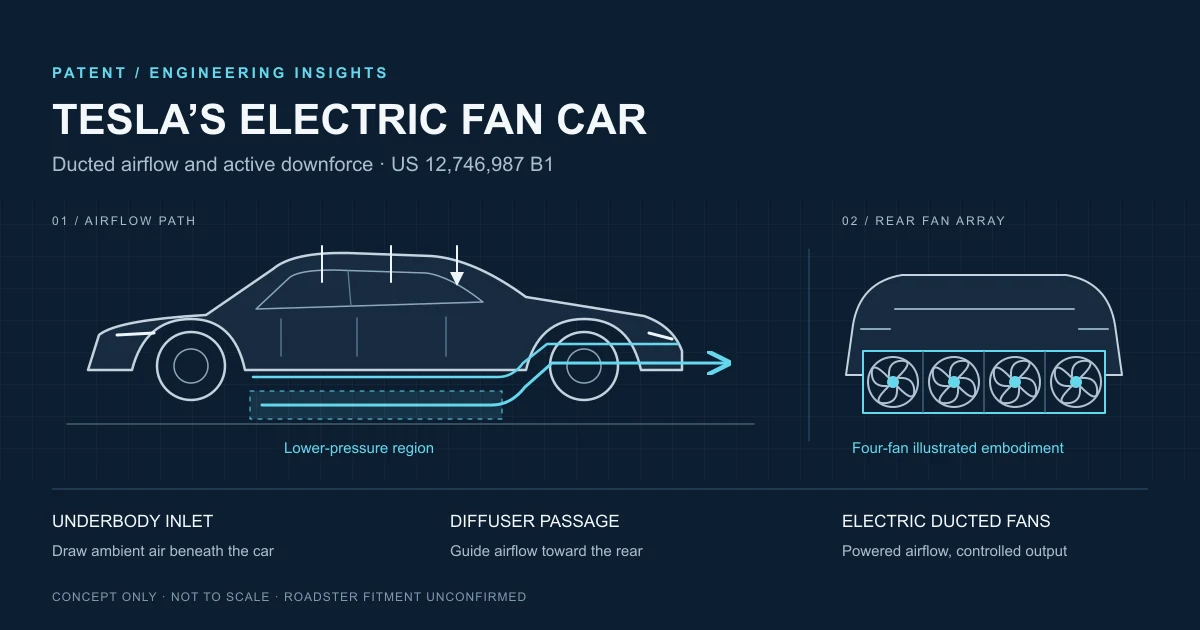
What the patent discloses: Tesla’s US12746987B1, Electric Fan Car, uses an underbody inlet, diffuser passage and electrically driven fan array to influence vehicle aerodynamics. What it does not establish: the patent does not name the Roadster, confirm production fitment or report measured fan power, downforce or noise. What this analysis explains: how pressure loading, installed fan operating points, electrical power and ride-height sensitivity should be evaluated together. Independent calculations are illustrative, not Tesla or Yuntu automotive test data.

Evaluating Industrial Drone Payload Capacity: Momentum Theory, Disk Loading Limits, and Heavy-Lift Powertrain SizingEngineering Sizing Guide
•12 min technical read

Evaluating Industrial Drone Payload Capacity: Momentum Theory, Disk Loading Limits, and Heavy-Lift Powertrain Sizing

Evaluating how much net payload an industrial heavy-lift drone can carry requires moving beyond speculative claims to rigorous flight mechanics: the mass fraction balance equation, Rankine-Froude momentum theory, disk loading divergence, and ducted fan thrust augmentation.

From 85 dB Harsh Whine to 53 dB Ambient Whisper: Aeroacoustic Engineering for Urban Vertiport ComplianceAeroacoustic Engineering
•15 min technical read

From 85 dB Harsh Whine to 53 dB Ambient Whisper: Aeroacoustic Engineering for Urban Vertiport Compliance

In Urban Air Mobility (UAM), the primary commercialization bottleneck is rarely aerodynamic lift—it is community noise opposition at rooftop vertiports. Open rotors emitting piercing 78–85 dBA tonal spikes trigger immediate regulatory curfews. Drawing upon certified anechoic wind tunnel testing, this monograph demonstrates how electric ducted fans utilize 0.6mm micro-tip clearance, aperiodic blade spacing, and micro-perforated Helmholtz resonator liners to suppress sound pressure levels down to 53 dBA at 30 meters, transforming propulsion noise into a benign ambient breeze.

The Zero-Airspeed Hover Trap: Why Electric Aircraft Overheat in Hover and How Ducted Fans Survive 50°C Desert OperationsAerospace Thermal Engineering
•16 min technical read

The Zero-Airspeed Hover Trap: Why Electric Aircraft Overheat in Hover and How Ducted Fans Survive 50°C Desert Operations

In electric aviation, conventional wisdom assumes forward cruise imposes the harshest thermal loads. Flight engineering proves the exact opposite: propulsion systems experience their most dangerous thermal crisis during continuous zero-airspeed hover. Without forward dynamic ram air, traditional open motors overheat within 4 to 8 minutes in 50°C desert heat, triggering emergency power de-rating and catastrophic loss of altitude. This monograph reveals how electric ducted fans utilize inlet aerodynamic suction pressure to drive self-induced forced cooling air and deploy internal stator microchannel oil loops, achieving steady-state thermal convergence at 118°C under continuous 100% hover thrust in 50°C ambient conditions.

Physical Limits and Sizing Trade-offs of Industrial Drone Range: Electric Breguet Formulation and Cruise Drag ReductionRange Engineering & Energy Sizing
•14 min aerospace engineering whitepaper

Physical Limits and Sizing Trade-offs of Industrial Drone Range: Electric Breguet Formulation and Cruise Drag Reduction

In industrial UAV preliminary sizing, flight radius is not an isolated motor catalog specification; it is an integrated outcome dictated by battery specific energy, structural mass allocation, cruise lift-to-drag ratio (L/D), and whole-powertrain electrical-to-fluid conversion efficiency. A governing characteristic of electric aircraft is that the mass of electrochemical energy storage remains invariant throughout the mission envelope. Once the battery mass fraction exceeds a critical aerodynamic threshold, structural empty weight penalties and induced drag escalation rapidly erode marginal range returns. Drawing upon the electric Breguet range formulation and empirical telemetry from a 50kg hybrid-wing testbed, this technical whitepaper audits energy dissipation pathways from cell capacity to wake jet momentum, establishing why powertrain efficiency optimization and nacelle drag suppression are primary engineering levers for breaking range ceilings without mass penalty.

High Hover Thrust vs Low Cruise Drag: Aerodynamic Decoupling and Transition Corridor Dynamics for Hybrid-Wing PropulsionAero-Dynamics & Transition Envelopes
•15 min flight dynamics whitepaper

High Hover Thrust vs Low Cruise Drag: Aerodynamic Decoupling and Transition Corridor Dynamics for Hybrid-Wing Propulsion

In the aerodynamic and structural sizing of vertical takeoff and landing (VTOL) hybrid-wing and tilt-propulsion aircraft, propulsion architects confront severe operating regime contradictions: vertical liftoff occurs at zero forward dynamic pressure, requiring thrust-to-weight ratios (T/W) of 1.3 to 1.8 to directly balance gross weight via slipstream momentum flux; once the aircraft completes transition into 160–220 km/h wing-borne cruise, aerodynamic lift fully supports aircraft weight, causing required thrust to plunge to 1/10 or 1/15 of liftoff thrust. Without powertrain decoupling and aerodynamic airframe integration, conventional systems suffer from inverter efficiency collapse under low duty cycles, severe stopped-rotor bluff drag, and narrow transition stall margins. This whitepaper deconstructs dual-regime fluid mechanics, maps out the three-stage transition corridor timeline, and presents a five-architecture comparative decision matrix alongside airframe integration guidelines.

Electric Jet vs. Electric Ducted Fan: Aerodynamic Realities, Acoustic Limits, and High-Thrust Powertrain IntegrationPropulsion Aerodynamics & Technology Explainer
•12 min aerospace engineering whitepaper

Electric Jet vs. Electric Ducted Fan: Aerodynamic Realities, Acoustic Limits, and High-Thrust Powertrain Integration

In advanced air mobility (AAM) and electric aviation, the term "Electric Jet" is frequently used by media and stakeholders to describe aircraft powered by enclosed impellers (such as the vectored-fan architecture used by Lilium). Aerodynamically and thermodynamically, however, there is no physical pure-electric jet engine operating on thermal gas expansion. What industry professionals and the public refer to as an "electric jet" is an integrated, multi-blade, shrouded Electric Ducted Fan (EDF) powertrain equipped with deswirling stator vanes and acoustic liners. This whitepaper explains the physical differences across Froude propulsive efficiency, momentum theory, noise mitigation, FAR 33.19 blade containment certification, and the distinction between hobbyist RC units and certified 60kgf–1000kgf aviation powertrains.

How to Size UAV Electric Propulsion Systems: Step-by-Step Powertrain Engineering GuidePowertrain Sizing & Architecture Engineering
•15 min aerospace engineering whitepaper

How to Size UAV Electric Propulsion Systems: Step-by-Step Powertrain Engineering Guide

In industrial UAV and electric vertical takeoff and landing (eVTOL) preliminary design, propulsion sizing cannot be reduced to selecting a catalog motor based on nominal thrust. The powertrain is coupled to airframe aerodynamics, structural mass fraction, high-voltage bus architectures, and continuous thermal equilibrium. Sizing errors made during preliminary definition lead to excessive hovering power, cruise efficiency collapse, excessive wiring harness mass, and thermal derate failures in harsh environments. Moving beyond generic product catalogs, this whitepaper outlines a first-principles sizing methodology: engineering input matrices, actuator disk momentum formulation, disk loading optimization, distributed (DEP) versus lumped topologies, 400V–800V bus trade-offs, and continuous stator thermal equilibrium, complete with an end-to-end 150kg hybrid-wing cargo UAV sizing case study.

Payload vs. Endurance Trade-offs in Industrial UAVs: An Engineering Analysis Based on Momentum Theory and Mass BudgetsFlight Mechanics & Aircraft Performance
•15 min technical read

Payload vs. Endurance Trade-offs in Industrial UAVs: An Engineering Analysis Based on Momentum Theory and Mass Budgets

The coupling between useful payload mass and operational flight performance in industrial unmanned aircraft is fundamentally non-linear. Under actuator disk momentum theory, required induced hover power escalates with gross vehicle weight to the 3/2 exponent. Increasing payload demands disproportionately higher electrical power, forcing motor phase currents and battery C-rates into high-loss regimes and inducing severe electrochemical capacity derating. Concurrently, wing-induced drag in forward cruise scales with the square of gross weight. When the vehicle battery mass fraction approaches its theoretical ceiling, expanding battery capacity yields zero net range extension. This paper establishes a quantitative aeromechanical evaluation framework across hover dynamics, powertrain energy flow, and aircraft mass budget sensitivity, providing concrete sizing criteria for heavy-lift multirotor and winged VTOL configurations.

Low-Noise Fan Design for Cooling Towers and Data Centers: Micro-Perforated Liners and Source Noise Control Without Thermal DeratingIndustrial Acoustics & Thermal Flow Physics
•14 min technical read

Low-Noise Fan Design for Cooling Towers and Data Centers: Micro-Perforated Liners and Source Noise Control Without Thermal Derating

In data center thermal infrastructures, large cooling towers, and industrial heat rejection equipment, reconciling aerodynamic noise attenuation with design heat rejection capacity presents an acute mechanical conflict. Conventional mitigation relies on aftermarket discharge silencer baffles, acoustic louvers, or VFD rotational speed derating. However, the 50 to 160 Pa aerodynamic static pressure penalty introduced by dissipative silencers forces axial fan operating points into stalled, low-volume zones. The resulting plunge in airflow mass flow rate causes irreversible Cooling Capacity Thermal Derate, degrading approach temperatures and risking chiller compressor trip-offs. To resolve this aeromechanical bottleneck, this paper evaluates the transfer of aerospace ducted fan source-noise control to industrial air handlers: suppressing tip-leakage vortices via high-tolerance shrouds, attenuating blade pass frequency (BPF) tones via Tyler-Sofrin modal cut-off, and deploying flush-mounted micro-perforated panel (MPP) Helmholtz acoustic liners to achieve robust sound insertion loss with zero added airflow restriction.

Engineered for Extreme Reliability & Low Noise

Looking for high-thrust electric ducted fan propulsion systems or custom wind tunnel verification? Connect directly with Yuntu’s powertrain engineering team.

Contact Propulsion Specialists