
After calculating lifting capacity, evaluate how the selected payload affects flight time and range in Industrial UAV Payload vs Endurance: W^(3/2) Power & Range.
For a delivery mission, review cargo drone thrust margin alongside the payload calculation.
1. Drone Payload Capacity Calculations: Mass Budget Formula
In conceptual aircraft design, payload capacity is strictly constrained by the fundamental takeoff mass budget equation:
A common engineering pitfall is attempting to increase payload or flight duration simply by stacking additional battery capacity. Because battery mass is deadweight that continuously demands aerodynamic lift, expanding the battery mass fraction beyond 45% causes a steep non-linear divergence in induced power consumption, elevating motor winding thermal load and diminishing net useful payload.
2. Rankine-Froude Momentum Theory and Disk Loading Boundaries
Hovering flight is fundamentally governed by the Rankine-Froude momentum theory for an idealized actuator disk. The induced hover power (P_induced) is mathematically expressed as:
However, for heavy-lift industrial unmanned aircraft (MTOW >= 100kg to 1000kg+), the open propeller architecture encounters catastrophic physical scaling bottlenecks:
- Critical Tip Mach Divergence: Generating 40kgf to 100kgf per rotor on open blades requires diameters exceeding 40 to 60 inches. At operational RPM, blade tip speeds exceed Mach 0.65 to 0.75, triggering localized compressible transonic shock stall, boundary layer separation, and massive profile drag divergence.
- Aeroelastic Flutter and Gyroscopic Fatigue: Extreme blade spans experience intense cyclic flexural-torsional fluttering under turbulent wind shear, leading to structural micro-cracking and high angular gyroscopic precession moments that destabilize flight attitude loops.
- Uncontained Catastrophic Hazard: Open propellers spinning high-mass carbon tips pose grave safety hazards in urban infrastructure, maritime vessels, and industrial inspection zones. Any mechanical blade release results in uncontained multi-axis airframe damage.
3. Aerodynamic Physics of Ducted Fan Static Thrust Augmentation
Electric Ducted Fan (EDF) technology fundamentally resolves these physical limits by aerodynamically decoupling rotor diameter from thrust generation. A precisely contoured aerodynamic duct delivers four decisive fluid dynamic mechanisms:
- Duct Lip Suction Peak: Accelerated inflow into the convergent duct inlet establishes a severe negative pressure peak over the duct lip profile. This integrated pressure differential contributes 40% to 52% of the overall total static thrust directly through the stationary shroud, offloading mechanical torque from the rotating shaft.
- Elimination of Blade Tip Vortices: Operating multi-blade composite impellers with ultra-tight radial tip clearances (0.4mm to 0.8mm) completely suppresses tip spanwise vortex roll-up, converting vortex dissipation energy into pure axial momentum.
- Diffuser Static Pressure Recovery: The divergent rear duct section facilitates steady pressure recovery and eliminates slipstream contraction (vena contracta), elevating mass flow rate and propulsive efficiency.
- Structural Blade Containment: Heavy-gauge high-modulus carbon fiber outer cowlings provide full ballistic-level fragment containment, certifying operational safety for human-adjacent and mission-critical flights.
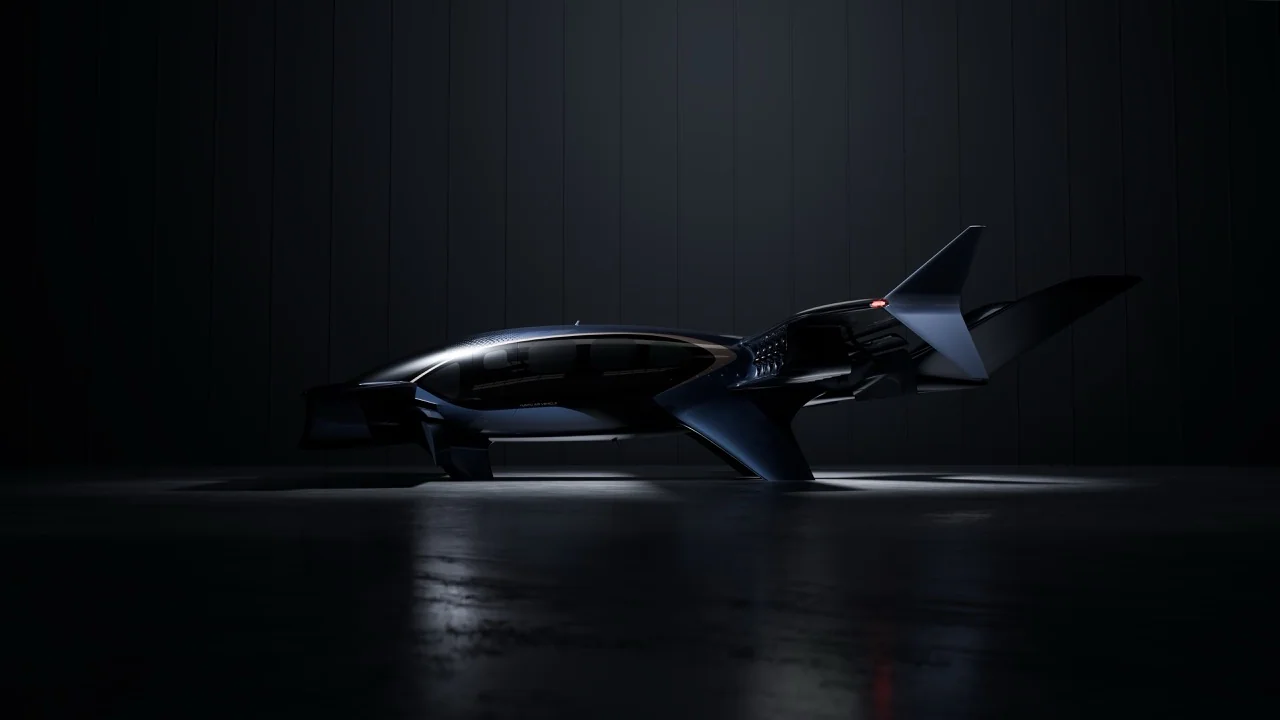
Real-World Comparative Sizing: 200kg MTOW High-Altitude Disaster Response Drone
Scenario: A regional civil protection agency requires an industrial VTOL drone capable of transporting an 80kg critical emergency medical and satellite communication payload across mountainous terrain (2,000m pressure altitude, Beaufort 6 gusts up to 12 m/s), demanding a minimum 25-minute hover endurance.
- Step 1: Dynamic Thrust-to-Weight Sizing: For certified flight stability in mountainous crosswinds, required TWR = 2.0. Total Peak Thrust = 200kg * 2.0 = 400 kgf.
- Step 2: Architecture A (Open Propeller Hexacopter): Requires 6x 42-inch (1.07m) carbon blades. Vehicle diagonal motor-to-motor wheelbase expands to 2.95m. Under 12 m/s gusts, attitude loop lag exceeds 180ms due to huge rotational inertia, causing dangerous altitude drops and structural resonance.
- Step 3: Architecture B (Yuntu YTN-100 Quad Ducted Fan Array): Employs 4x YTN-100 (100kgf peak thrust per pod, 420mm diameter). Total vehicle span contracts to 1.35m (54% reduction in footprint). 11-blade high-solidity impellers feature ultra-low rotational inertia, yielding <50ms motor acceleration response.
- Step 4: Flight Power Verification: Hover power is 48.2 kW at 200kg MTOW. The 62kg battery pack delivers 17.3 kWh usable energy. Reserving 15% of that energy gives an estimated hover time of 17.3 × 0.85 / 48.2 × 60 ≈ 18.3 minutes at constant power.
| Target MTOW | Operational Payload | Total Required Thrust (TWR 1.8-2.2) | Optimal Powertrain Configuration | System Bus Voltage | Primary Mission Profiles |
|---|---|---|---|---|---|
| 20 kg | 6 - 9 kg | 36 - 44 kgf | 4x YTN-10 (10kgf per pod) | 48V - 72V DC | Emergency medical delivery, security surveillance, pipeline patrol |
| 50 kg | 15 - 22 kg | 90 - 110 kgf | 4x YTN-30 (30kgf per pod) | 100V - 150V DC | Forestry lidar, defense reconnaissance, pipeline patrol |
| 100 kg | 30 - 45 kg | 180 - 220 kgf | 4x YTN-60 (60kgf) | 150V - 200V DC | Agricultural spraying, maritime logistics, tethered comms |
| 200 kg | 65 - 90 kg | 360 - 440 kgf | 4x YTN-100 or 8x YTN-60 (60kgf) | 350V - 450V DC | Disaster medical relief, offshore oil rig cargo transport |
| 500 kg | 160 - 230 kg | 900 - 1100 kgf | 4x YTN-250 or 6x YTN-200 (200kgf) | 600V - 800V DC | Heavy industrial equipment lifting, 2-seat eVTOL testbeds |
| 1000+ kg | 350 - 500 kg | 1800 - 2200 kgf | 4x YTN-500 (500kgf) or 8x YTN-250 | 800V - 1000V DC | Commercial air taxi, autonomous multi-pallet cargo transit |
4. Dynamic Thrust-to-Weight Ratio Sizing and Altitude De-rating Principles
Flight safety standards dictate that static hover thrust is only one dimension of powertrain sizing. When deploying heavy unmanned systems into complex real-world conditions, engineers must rigorously account for environmental de-rating:
- Atmospheric Air Density Derating: Air density decreases with pressure altitude and elevated temperature according to the barometric formula. At 2,500m elevation and 40°C ambient, density drops by ~26%, directly reducing rotor thrust by an identical percentage unless motor RPM is dynamically escalated.
- One-Engine-Inoperative (OEI) Thrust Margin: For multi-rotor platforms requiring certified fail-safe recovery, remaining operational thrusters must instantly compensate for a failed unit while maintaining hover attitude, mandating base nominal operating points below 65% of maximum continuous rating.
- Acoustic Footprint Compliance: Yuntu ducted fans incorporate stator-rotor acoustic phase tuning and sound-absorbing duct liners, achieving 18 dBA lower noise levels than equivalent-thrust open propellers, enabling flights in sensitive urban corridors.
Frequently Asked Questions on Drone Payload Capacity (FAQ)
How do drone payload capacity calculations work?
First determine allowable takeoff mass as the lower of the airframe MTOW limit and total available static thrust in kgf divided by the chosen thrust-to-weight ratio. Then calculate net payload = allowable takeoff mass – empty airframe and equipment mass – battery mass. Using this guide’s TWR 2.0 example, 400 kgf of total thrust allows 200 kg takeoff mass; subtract 58 kg empty mass and 62 kg battery mass to obtain 80 kg net payload. Check power, energy reserves, and thrust at the intended temperature and altitude separately.
Why does doubling battery capacity not double a heavy drone flight time and payload?
Because battery mass contributes directly to aircraft empty weight without generating aerodynamic lift. As battery mass fraction exceeds 42%, the induced power required to hover escalates non-linearly. The additional battery is consumed simply carrying itself, elevating motor thermal dissipation and degrading net payload margins. For quantitative mathematical derivations and payload sensitivity laws, consult our whitepaper: [Industrial UAV Payload vs. Endurance Trade-offs: Momentum Theory & Mass Budgets](/blog/payload-vs-endurance-industrial-uav).
Can open propellers on an existing airframe be directly swapped for ducted fans?
Yes, provided bus voltage and mechanical mounting interfaces are properly matched. A 400mm diameter Yuntu ducted fan delivers identical static thrust to a 40-inch (1016mm) open propeller, saving over 600mm of arm span per axis while imparting IP56 environmental sealing and blade safety.
What is the certified safe Thrust-to-Weight Ratio for industrial heavy-lift drones?
While consumer hobby drones function at a minimal 1.5 TWR, industrial heavy-lift platforms require a minimum TWR of 1.8 to 2.2. This ensures deterministic attitude recovery in 12-15 m/s wind shear, adequate vertical climb rates, and sufficient reserve for motor fail-safe survivability.
How do high ambient temperatures and altitude affect payload capacity?
Both high elevation and extreme heat decrease ambient air density (ρ). At 2,500m elevation or 45°C ambient, air density drops by 20% to 28%, causing an equivalent loss in aerodynamic thrust. Yuntu custom EDF units feature high-torque flux-optimized motors capable of operating at elevated RPM to compensate for thin air and maintain rated payload.