Cargo Drones: Sizing Propulsion for Payload, Range and Thrust Margin
A cargo drone needs propulsion matched to its payload, route and operating conditions. Review the mass budget and available thrust before choosing a unit count or thrust class. Yuntu supplies 60–1000 kgf electric ducted fan propulsion units and integration support for aircraft developers and institutional operators.
This page covers propulsion supply and integration for cargo aircraft projects. Complete aircraft sales are outside the offering described here.
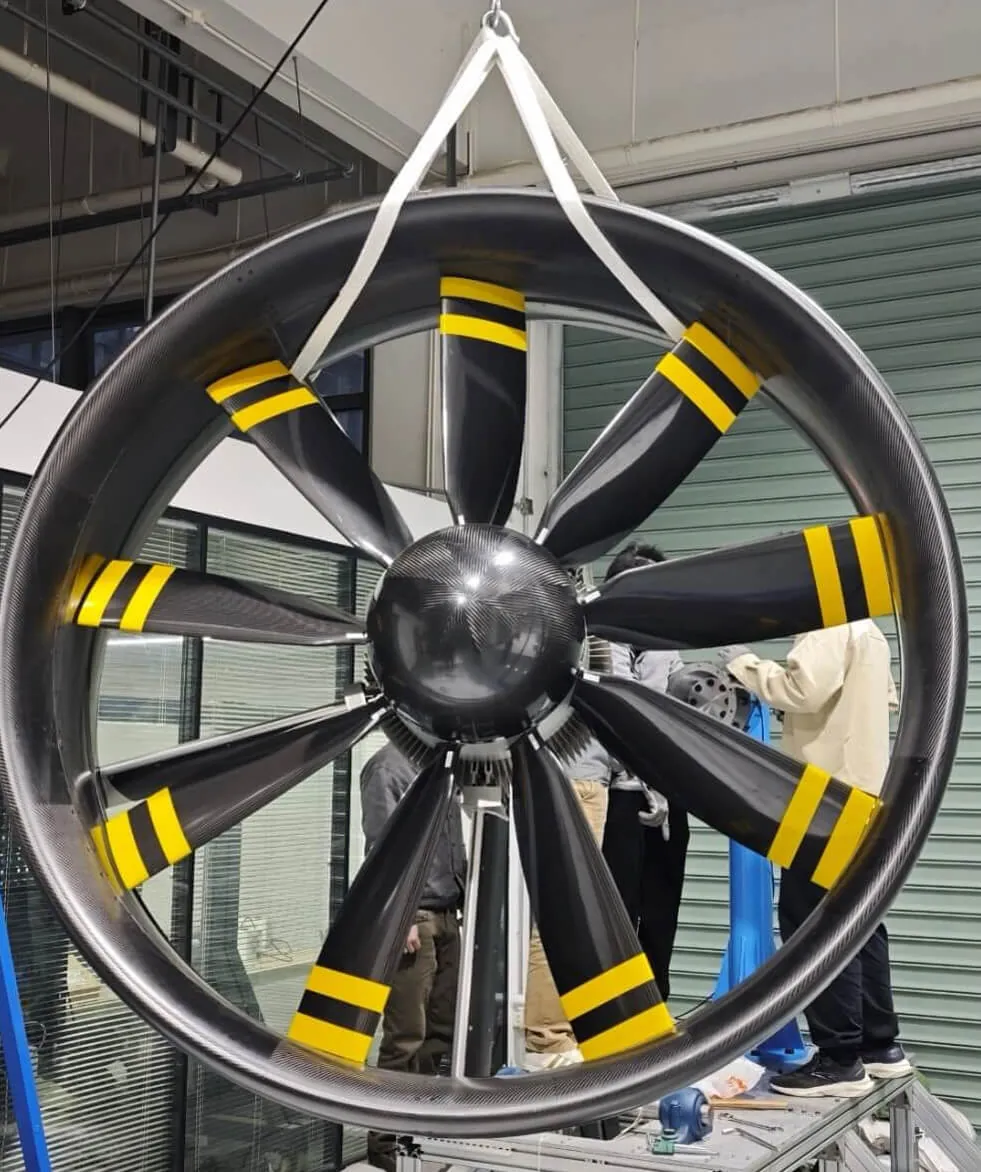
Yuntu ducted fan propulsion unit during handling.
4 thrust classes
60 · 200 · 500 · 1000 kgf
Ducted fan units
Rotor blades within a surrounding duct
Supply and integration
Propulsion units and engineering support
01
What Is a Cargo Drone?
A cargo drone is an uncrewed aircraft designed to transport goods. It may use rotors, a fixed wing, or vertical takeoff combined with wing-borne cruise. Its useful load and route length depend on the aircraft's mass, energy budget and installed propulsion, together with the conditions of the mission.
Start with the delivery task: the heaviest load, the route with that load, the landing sites and the operating conditions. These inputs help separate aircraft requirements from propulsion-unit ratings.
In the United States, Part 107 applies to drones weighing less than 55 lb at takeoff. FAA guidance describes a Section 44807 exemption application route for operations outside the weight limit.[1] The FAA also sets out a Part 135 certification process for package-delivery operators.[2]
02
Choose an Airframe for the Route
Compare landing access, hover requirements and route length before choosing an aircraft layout.
01
Multirotor
Consider for
Missions requiring vertical landing, hover or winching at constrained sites.
Check before sizing
Payload, hover duration and the space around each rotor.
Propulsion note
Check inlet and outlet clearance, installation mass and control requirements.
If the project uses a hybrid-electric energy system, review the engine, generator and battery duties alongside the propulsion layout. Explore hybrid drone powertrains.
03
Payload, Range and Thrust Margin
A cargo drone's payload, energy and thrust reserve share the same aircraft budget. Review them together at the intended takeoff mass.
Empty aircraft and equipment mass, excluding battery or fuel mass
m_energy
Battery mass or fuel mass at takeoff
m_payload
Mission payload mass
m_structural_limit
The aircraft's permitted takeoff mass limit
T_available
Total available thrust in kgf for the sizing condition
R_target
The project's target thrust-to-weight ratio
All mass terms are in kg; thrust in this expression is in kgf. Reserve energy belongs inside the battery or fuel budget and is not subtracted again as a separate mass. The thrust-based limit is a sizing estimate; structural limits and the intended operating conditions still apply.
At a fixed takeoff mass, more payload can leave less mass available for batteries or fuel. A change in aircraft weight can also change power demand. Evaluate hover, climb, cruise, delivery and reserve together, and compare range at the payload actually required.
Include sling motion, winch operation and changes in weight or balance during delivery in the mission review. These conditions require aircraft-level assessment alongside thrust sizing. Explore sling-load stability for heavy-lift drones.
Compare thrust at the loaded takeoff mass
For a cargo drone, compare total available thrust with the loaded takeoff mass, then repeat the calculation after removing one equal-rated unit. The examples below show arithmetic only. They do not establish an aircraft's controllability, operating limits or landing capability after a failure.
Arithmetic examples: takeoff mass and loss of one equal-rated unit
Configuration
Total thrust
Takeoff mass
T/W, all units
Thrust, one unit out
T/W, one unit out
6 × 200 kgf
1,200 kgf
600 kg
2.00
1,000 kgf
1.67
6 × 200 kgf
1,200 kgf
800 kg
1.50
1,000 kgf
1.25
6 × 200 kgf
1,200 kgf
1,000 kg
1.20
1,000 kgf
1.00
8 × 500 kgf
4,000 kgf
2,000 kg
2.00
3,500 kgf
1.75
8 × 500 kgf
4,000 kgf
2,700 kg
1.48
3,500 kgf
1.30
8 × 500 kgf
4,000 kgf
3,200 kg
1.25
3,500 kgf
1.09
Arithmetic examples: takeoff mass and loss of one equal-rated unit
All unitsOne unit out
A T/W of 1.00 means thrust equals weight in this simplified comparison. It says nothing about the distribution of forces, attitude control, gust response or transient performance. Define the required margin through the aircraft's engineering and validation process.
04
Select a 60–1000 kgf Thrust Class
Yuntu supplies four standard thrust classes. A unit's thrust rating is not an aircraft payload rating; select the class together with unit count, installation and mission conditions.
Electric ducted fan thrust classes and product details
Define the maximum payload, route and landing sites.
Prepare the empty-mass and energy budgets, including reserve energy.
Identify the unit count and installation space available.
Compare available thrust and the project's target margin, including the one-unit-out calculation.
Review control, cooling and duty cycle with the aircraft integration team.
05
Ducted Fans and Open Rotors in Cargo Operations
Compare the installed systems against the same cargo mission. The checklist focuses on people, lines, landing sites and the aircraft's mass and energy budgets.
Installation and operating checks for cargo missions
Factor
Ducted fan: check
Open rotor: check
Loading and unloading
Keep personnel clear of the inlet and outlet; standard procedures still apply.
Define personnel clearance around the exposed rotor disk; standard procedures still apply.
Sling lines and winch cables
Keep lines clear of the inlet, outlet and rotating components.
Keep lines clear of exposed rotor disks.
Pads and decks
Include outer duct size, mounting and installation clearance.
Include rotor swept area and operating clearance.
Dust, spray and loose cargo
Assess outlet flow at the actual loading and landing sites.
Assess rotor wake at the actual loading and landing sites.
Hover power
Compare installed power at the required thrust and operating conditions.
Compare installed power at the same required thrust and conditions.
Cruise
Include duct installation drag and the duty of lift units during cruise.
Include rotor installation drag and the duty of lift units during cruise.
Mass budget
Include the duct, mounts and related installation hardware.
Include rotor mounts and any required protective structures.
Selection basis
Review enclosure and site constraints alongside energy and mass.
Review rotor area and site constraints alongside energy and mass.
Use the mission to define the inputs for a cargo drone propulsion review. The examples below do not assign a payload capacity or thrust class to a route.
01
Ship-to-Shore and Offshore Supply
Move goods between vessels, ports and offshore facilities.
Sizing inputs
Landing-site dimensions, wind, spray, payload handling and the return route.
02
Island Logistics
Transport goods between mainland and island sites.
Sizing inputs
Outbound and return distances, landing access and reserve energy.
03
Mountain and Remote Sites
Deliver materials to sites with limited road access.
Sizing inputs
Landing altitude, weather, approach space and the loaded route.
04
Emergency Supply
Plan deliveries to disrupted or difficult-to-reach locations.
Sizing inputs
Site access, changing conditions and the cargo handling method.
05
Industrial Site Delivery
Move parts and consumables around industrial facilities.
Sizing inputs
Sortie frequency, hover segments, cooling and turnaround procedures.
06
Medical Supplies
Transport time-sensitive supplies to clinics and communities.
Sizing inputs
Handling requirements, route, reserve energy and the operating plan.
A cargo drone is an uncrewed aircraft designed to transport goods. It may use rotors, a fixed wing, or vertical takeoff combined with wing-borne cruise. Its useful load and route length depend on the aircraft's mass, energy budget and installed propulsion, together with the conditions of the mission.
02How much weight can a cargo drone carry?+
Start with the allowable takeoff mass and subtract empty aircraft and equipment mass, then battery or fuel mass. Include reserve energy in the energy budget without subtracting it twice. Available thrust also constrains the sizing estimate. A propulsion unit's kgf rating is not the aircraft's payload capacity; check the complete aircraft at the intended mission conditions.
03What determines a cargo drone's range?+
Range depends on usable energy, payload, aircraft layout and the power required through the mission. Include hover, climb, cruise, delivery and reserve rather than comparing a single flight segment. Review the route with the required payload and the return condition. For hybrid projects, include the engine, generator and battery duties in the same assessment.
04Which airframe type fits the route?+
Begin with landing access, hover requirements and route length. Compare multirotor, winged VTOL and fixed-wing layouts against those inputs, then include installation mass, transition requirements and mission energy. Select the propulsion with the aircraft developer so that a thrust rating is assessed in the context of the complete layout.
05Are ducted fans or open rotors a better fit?+
Compare the installed systems for the same payload, route and sites. Include personnel clearance, sling lines, inlet and outlet flow, installation mass, hover power and cruise drag. A surrounding duct changes the installation, but does not replace operating procedures. Neither option wins every mission; choose using the aircraft's requirements and validation results.
06How much thrust does a cargo drone need?+
The project must define its required thrust margin at the loaded takeoff mass. Calculate thrust-to-weight ratio using available thrust, then repeat the arithmetic for the selected failure condition. There is no recommended ratio on this page. The target depends on the aircraft, operating conditions and engineering validation, not the payload figure alone.
07What does losing one propulsion unit change?+
With N identical units, removing one leaves (N−1)/N of their summed thrust ratings: 75% for four units, 83.33% for six and 87.50% for eight. This is arithmetic, not a demonstrated failure capability. Thrust distribution, control response and installation conditions must also be evaluated before making any claim about continued flight or landing.
08How much does a cargo drone cost?+
This page does not price complete aircraft. The offering is electric ducted fan propulsion supply and integration support. To request a propulsion quotation, share the aircraft layout, payload, route, target takeoff mass and planned unit count. Our team can then review the configuration and discuss the scope of supply and integration.
09Do cargo drones need special approval?+
Requirements depend on the aircraft and operation. FAA guidance explains Part 107's weight limit and a Section 44807 exemption route.[1] It also describes Part 135 certification for package-delivery operators.[2] EASA lists international IFR flights of certified cargo drones among examples discussed for its certified category.[3] These references do not establish approval for a particular project.
10What does Yuntu supply for cargo drone projects?+
Yuntu supplies electric ducted fan propulsion units in the 60, 200, 500 and 1000 kgf classes, together with sizing and integration support. This page is intended for aircraft developers and institutional operators reviewing a propulsion system. Complete aircraft sales are outside the offering described here; share the mission inputs to discuss the propulsion scope.