
In the commercialization of Urban Air Mobility (UAM) and all-electric aviation, the choice of propulsion architecture dictates vehicle payload fraction, passenger comfort, urban community acceptance, and civil airworthiness certification pathways. The long-standing debate between open rotors and Electric Ducted Fans (EDF) has historically lacked full-scale comparative test data. Drawing upon Yuntu’s extensive wind tunnel calibration and dynamometer thrust test rigs, this article provides a comprehensive fluid dynamics and acoustic physics comparison between the two paradigms.
1. Fluid Dynamics: Tip Vortex Elimination and Duct Lip Suction Augmentation
Conventional open propellers inevitably bleed high-pressure air from the blade pressure side to the upper suction surface, producing massive 3D blade-tip vortices. These induced flow structures convert 15% to 25% of shaft mechanical power into turbulent wake drag rather than usable axial thrust, simultaneously degrading downwash airflow quality over trailing airfoils.
In contrast, an optimized Electric Ducted Fan enforces micro-radial tip clearance (precisely maintained between 0.8mm and 1.2mm across Yuntu’s production units). The rigid structural duct acts as an aerodynamic boundary wall, suppressing cross-stream tip spillover. This maintains near-uniform spanwise lift coefficients and dramatically raises effective rotor aspect ratio.
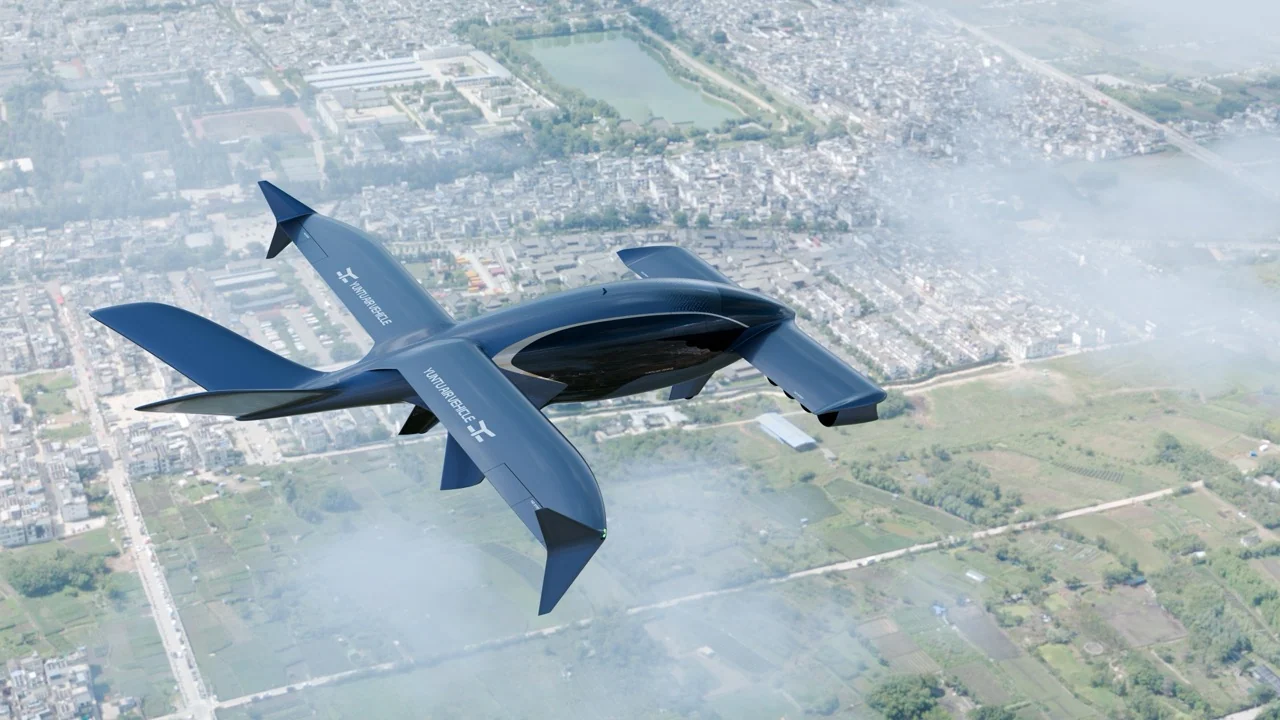
Crucially, the duct shroud generates positive forward aerodynamic force through "lip suction". As the rotor accelerates freestream air, localized static pressure drops steeply over the curved leading lip. Surface pressure integration (∮ P·dA) yields forward net axial force. In hover conditions, duct lip suction contributes 20% to 35% of total system static thrust, reducing rotor torque and motor current draw.
2. Acoustic Engineering: Slashing Discrete Harmonics Down to 53 dB(A) at 100m
Urban vertiport operations impose strict acoustic thresholds. In pioneer initiatives like the UAE and Dubai Advanced Air Mobility network regulated by GCAA CAR-HVD, low noise footprint is a legal prerequisite for commercial flight approval. Open rotors emit sharp, low-frequency blade passage tones (BPF) that penetrate residential construction, triggering severe community resistance. Ducted fans fundamentally alter acoustic directivity and dispersion:
- Acoustic Duct Shroud Shielding: The cylindrical cowl physically intercepts radial dipole sound radiation, confining noise emission into axial forward and aft cones.
- Micro-Perforated Acoustic Liners: Integrated micro-perforated Helmholtz resonator damping inside the duct cowl attenuates 1000Hz-4000Hz tonal whine by over 18 dB.
- Non-Uniform Rotor Blade Spacing: Aperiodic circumferential blade pitch distribution modulates harmonic acoustic phase, scattering discrete spikes into broadband pink noise.
- Rotor-Stator Axial Separation: Positioning structural stator vanes over 1.5 rotor chord lengths downstream prevents rotor-wake impingement pressure shocks.
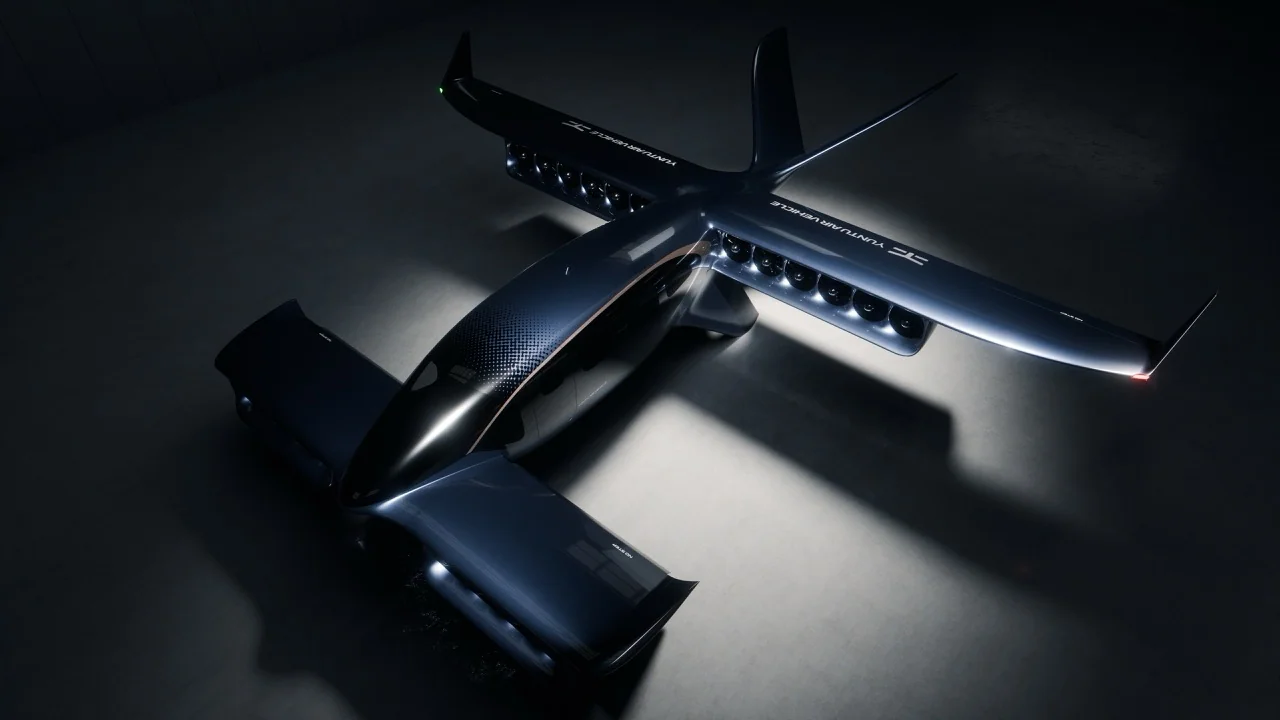
3. Airworthiness Certification: Blade Containment and Passenger Safety
Under FAA Part 23 and EASA SC-VTOL airworthiness requirements, rotating propulsion systems must guarantee passenger cabin integrity. Open rotor blades operating at 180 m/s tip speeds present severe operational hazards to ground ground crews. More dangerously, blade liberation caused by foreign object debris (FOD) can pierce cabin pressurized fuselages.
Yuntu’s carbon-aramid composite duct cowl functions as an energy-absorbing ballistic ring. Molded under automated high-pressure autoclave processes, it successfully absorbs the kinetic energy of a full blade release at 120% redline overspeed, fully satisfying commercial transport category containment mandates.
| Engineering Metric | Yuntu Electric Ducted Fan | Traditional Open Rotor | Operational Impact |
|---|---|---|---|
| Tip Vortex Induced Losses | Virtually eliminated by rigid micro-seal | Severe tip vortex drag generation | 20%-35% static thrust gain in hover |
| Sound Pressure (100m) | 53 dB(A) broadband soft signature | 76-85 dB(A) harsh harmonic whine | Meets urban vertiport day/night limits |
| Blade Liberation Containment | Integrated ballistic composite casing | Zero containment shield | Meets FAA Part 23 / EASA safety mandates |
| Ground Crew Hazard | Enclosed rotor eliminates blade strike | High revolving blade collision danger | Lowers apron separation perimeter costs |
| High-Speed Cruise Drag | Diffused clean inlet streamline flow | Large disk profile drag penalties | Enables 250-300 km/h continuous cruise |
4. Engineering Conclusion & Propulsion Trajectory
From analytical momentum theory to full-scale flight testing, electric ducted fans demonstrate decisive aeromechanical advantages for passenger eVTOL and high-performance UAV platforms. Beyond an enclosed rotor, an optimized EDF integrates diffusion augmentation, acoustic suppression, ballistic containment, and high-density electrical machines into a flight-certified aerospace propulsion system. For aerodynamic thrust augmentation proofs and full-scale sizing, explore our Electric Ducted Fan Technical Whitepaper; to evaluate full-spectrum aircraft electric architectures, explore our Electric Aircraft Propulsion Hub; for grid inspection, high-durability defense, and industrial operations, inspect the Commercial & Industrial Drone Propulsion Manual; to evaluate multi-thruster distributed architecture and 800V bus topology, consult the eVTOL Ducted Propulsion Integration Blueprint. For industrial logistics and high-capacity freight platforms, explore our Heavy Lift Drone Propulsion System Guide; for high-speed corridor surveillance, review the VTOL & Fixed-Wing Drone Propulsion Blueprint; for dedicated propulsion hardware specs, inspect the 200kgf Aviation EDF Unit (YTF-200) and 1000kgf Megawatt Thruster (YTF-1000); for regional deployment qualification logs, inspect the Saudi Arabia Desert Powertrains Hub and UAE Air Mobility Hub; furthermore, active ducted fan ground-effect suction extends to high-performance automotive aerodynamics, as evaluated in our Tesla Electric Fan Car Patent (US 12,746,987 B1) Engineering Review.
Frequently Asked Engineering Questions (FAQ)
How much quieter is an electric ducted fan compared to an open propeller?
Open rotors emit sharp discrete blade passage tones between 75-85 dB(A) at 100m. Ducted fans utilize cylindrical cowl shielding, micro-perforated Helmholtz acoustic liners (attenuating whine by >18 dB), and aperiodic blade spacing to scatter spikes into a gentle 53 dB(A) broadband signature compliant with urban vertiports.
Does duct lip suction really augment vertical hover thrust?
Yes. As incoming air accelerates into the high-curvature duct inlet, localized static pressure drops steeply over the forward lip. Integrating surface pressure (∮ P·dA) generates positive axial force contributing 20% to 35% of total static thrust in hover, substantially decreasing electrical motor power demand.
How does an enclosed ducted fan satisfy transport category airworthiness?
Under FAA Part 23 and EASA SC-VTOL, passenger cabins must be shielded from severed blade release. Yuntu cowls integrate a high-modulus aramid-carbon ballistic containment ring engineered to absorb the full kinetic impulse of a blade detachment at 120% redline overspeed, eliminating fuselage puncture hazards.