
Long-Endurance UAV Electric Propulsion: Aerodynamics, Cruise Sizing & Range Trade-Offs
Break the "heavy battery dead-weight spiral." Size matched electric ducted propulsion for high-efficiency fixed-wing and VTOL cruise envelopes based on empirical Breguet sensitivity derivations.
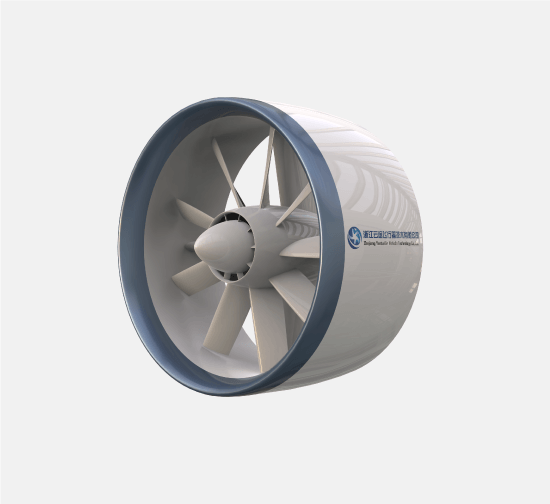
Maximizing industrial UAV flight range is not achieved by simply strapping on larger batteries—doing so triggers a spiral of gross takeoff weight (MTOW) penalty and structural mass escalation. Under the Breguet range framework, true endurance extension is governed by the product of cruise aerodynamic lift-to-drag ratio (L/D) and propulsion overall conversion efficiency (η_prop). Yuntu electric ducted fans optimize nacelle lip suction and eliminate wake swirl via deswirl stators, cutting aft-fuselage parasitic separation and elevating cruising system efficiency to ≥84.7% at speeds above 100 km/h.
Interactive Cruising Power & Thrust Sizing Workbench
Select aircraft Maximum Takeoff Weight (MTOW) and design cruise airspeed to compute required level-flight thrust, electrical power draw, and recommended Yuntu ducted powertrain class in real time.
Fuselage & Nacelle Aerodynamic Integration Topologies
Where propulsion units are mounted defines total airframe parasite drag and Boundary Layer Ingestion (BLI) benefits. Review three distinct industrial configurations.
Aft-Fuselage Pusher Nacelle
Ingests fuselage boundary layer airflow to energize sluggish wake flow, suppressing tailcone separation and reducing total fuselage parasitic drag by 12% to 18%.
Requires tail skid clearance verification during high angle-of-attack takeoff/landing rotation.
Underwing Podded Nacelles
Distributed twin/quad pods align efflux with the wing pressure gradient, providing differential yaw control authority and clean one-engine-inoperative (OEI) margins.
Increases wing bending moments and total wetted friction area; demands carbon spar reinforcement.
Nose Tractor Nacelle Integration
Accelerated slipstream energizes inner wing root lift, lowering stall speeds and shortening ground rollout.
High-velocity exhaust continuously scrubs the entire airframe surface, incurring an 8% to 14% friction drag penalty.
Breguet Sensitivity Matrix: Why Propulsion Efficiency is the Master Lever
Taking the logarithmic derivative of the Breguet electric range equation reveals the true percentage contribution of each engineering design factor on total mission distance.
Because battery specific energy (E_batt) is limited by electrochemical safety constraints, boosting propulsion conversion efficiency (η_prop) from 65% to 85% delivers an immediate 30%+ range extension without adding a single gram of dead weight.
Mission Flight Phases & Energy Expenditure Staircase
A comprehensive profile deconstruction of a typical 6-hour industrial patrol flight, showing power demand transitions across all flight regimes.
Phase 01: Vertical Takeoff & Outbound Transition
High-torque hover and aerodynamic wing-borne handoff
Phase 02: Best-Rate-of-Climb to Cruising Altitude
Dynamic pressure ramp-up; nacelle lip suction begins contributing forward thrust
Phase 03: High-Altitude Economic Cruise & Loiter
Steady-state design sweet spot; SiC inverter at peak 98.2% efficiency
Phase 04: Controlled Descent & Precision Recovery
Low throttle setting; thermal dissipation and safe touchdown
Frequently Answered Aerodynamic & Range Questions
Request Airframe Cruise Simulation & Sizing Dossier
Submit your wing aspect ratio, target cruise airspeed, and MTOW. Yuntu aeromechanics engineers will provide coupled CFD duct matching and cruise energy balance reports.