
For decades, the term "Electric Ducted Fan" (EDF) was almost exclusively associated with radio-controlled model jets—compact plastic impellers spanning 64mm to 120mm producing a few kilograms of thrust. Today, the rise of Urban Air Mobility (UAM), high-capacity industrial cargo drones, and hybrid-electric regional aircraft has driven an unprecedented technological revolution. Electric ducted fans have scaled by orders of magnitude, evolving into massive, carbon-composite propulsion systems capable of delivering nearly 10,000 Newtons of static thrust.
1. The Scale Evolution: From RC Hobby Impellers to Transport-Category Aviation Thrusters
The trajectory of electric ducted fan technology can be categorized into four distinct evolutionary tiers based on rotor diameter, input electrical power, and certification scope:
- Tier 1: Hobby & Model Jet Impellers (50mm – 120mm): Operating on 12V–48V LiPo packs, producing 1 kgf to 10 kgf. Made of injection-molded nylon or carbon-filled plastics with basic outrunner motors.
- Tier 2: Tactical UAV & Target Drone Propulsors (150mm – 300mm): Operating on 50V–100V DC, delivering 15 kgf to 35 kgf. Used in military target drones and high-speed reconnaissance quadcopters.
- Tier 3: Industrial Heavy-Lift & Light eVTOL Propulsion (600mm – 1200mm): High-voltage 400V–600V DC architectures generating 60 kgf (588 N) to 200 kgf (1,960 N). Exemplified by Yuntu YTF-60 and YTF-200 units powering 100kg+ payload delivery platforms and air taxis.
- Tier 4: Megawatt Commercial Transport Class (1200mm – 1900mm): High-density 800V SiC bus architectures delivering 500 kgf to 1000 kgf (4,900 N to 9,800 N). These are the largest electric ducted fans ever developed, engineered to propel regional airliners, heavy logistics platforms, and hybrid cargo airships.
2. The Engineering Barrier: Why Building a Large Electric Ducted Fan is Exceptionally Difficult
Scaling a ducted fan is fundamentally non-linear. As fan diameter doubles, disk area quadruples, but centrifugal forces on the blade roots scale with the square of the rotational speed and the cube of the radius. Building an aerodynamic duct with a diameter exceeding 1.2 meters presents three extreme aerospace engineering bottlenecks:
Secondly, motor torque and thermal dissipation scale dramatically. Generating 1000 kgf of thrust requires approximately 600 kW of continuous shaft power. Delivering 600 kW at low voltage would require cables thicker than a human arm. Large EDFs necessitate 800V DC bus architectures combined with silicon carbide (SiC) inverters, direct stator liquid cooling, and ram-air self-aspirated thermal management.
| Metric / Parameter | Hobby EDF (120mm) | UAV EDF (250mm) | Yuntu YTF-60 | Yuntu YTF-200 | Yuntu YTF-1000 (World Class) |
|---|---|---|---|---|---|
| Rotor Diameter | 0.12 m (4.7 in) | 0.25 m (9.8 in) | 0.60 m (23.6 in) | 1.20 m (47.2 in) | 1.60 m (63.0 in) |
| Nominal Static Thrust | 8.5 kgf (83 N) | 32 kgf (314 N) | 60 kgf (588 N) | 200 kgf (1,960 N) | 1,000 kgf (9,800 N) |
| Rated Input Power | 4.2 kW | 12.5 kW | 22 kW | 50 kW | 600 kW |
| Bus Operating Voltage | 48V DC | 96V DC | 400V DC | 600V DC | 800V DC |
| Power Loading (kgf/kW) | 2.02 kgf/kW | 2.56 kgf/kW | 2.72 kgf/kW | 4.00 kgf/kW | 1.67 kgf/kW (High-Speed Cruise) |
| Acoustic Footprint | 98 dB @ 1m whine | 92 dB @ 10m | 62 dB(A) @ 50m | 53 dB(A) @ 100m | 53 dB(A) @ 100m (Broadband) |
| Containment Shroud | None (Plastic) | None (Thin Carbon) | Aramid Ballistic Ring | Aramid Ballistic Ring | Full FAA Part 23 Ballistic Armored Ring |
3. Deep Dive into the World’s Largest EDF: YTF-1000 Megawatt Aviation Thruster
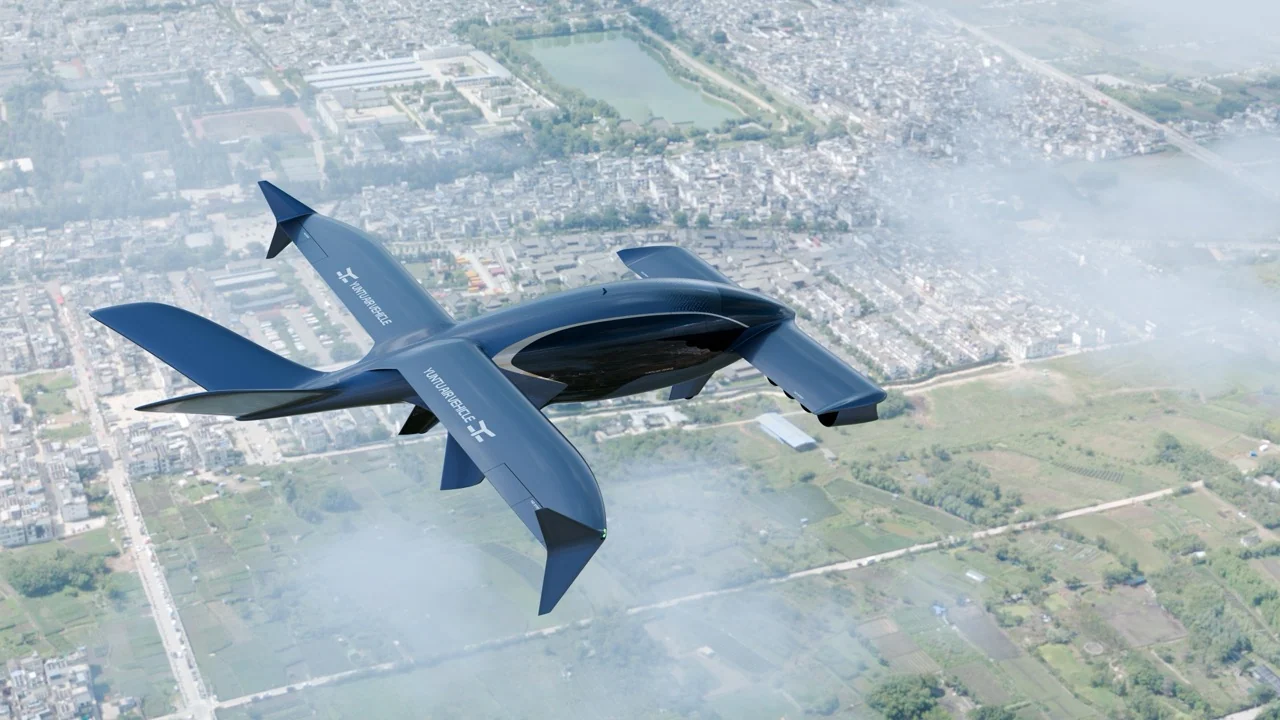
Standing at 1.6 meters in outer cowl diameter and delivering 1000 kgf (9,800 N) of peak static thrust, the Yuntu YTF-1000 represents the pinnacle of modern electric ducted propulsor engineering. Designed for regional passenger eVTOL aircraft, heavy logistics drones, and heavy-lift electric airships, its architecture incorporates several aerospace breakthroughs:
- Megawatt-Class Permanent Magnet Synchronous Motor: Features a hollow outer-rotor direct-drive configuration with high-grade Halbach array NdFeB permanent magnets, achieving a torque density exceeding 22 N·m/kg.
- Aramid-Carbon Ballistic Containment Ring: Integrated directly into the outer shroud, engineered to absorb the full kinetic impulse of a blade detachment at 120% redline overspeed (2,700 RPM) in full compliance with FAA Part 23 and EASA CS-E airworthiness codes.
- Micro-Perforated Acoustic Helmholtz Liners: Suppresses blade-passage tonal whine by over 18 dB, converting harsh single-frequency pulses into a gentle 53 dB(A) broadband signature measured at 100 meters sideline distance.
- Convergent Lip Suction Aerodynamics: Generates 25% to 32% of total vertical static lift purely through leading-edge intake pressure integration, drastically cutting hover electrical draw.
4. Target Missions: Where Large-Diameter EDFs Outperform Open Rotors
Why would an aircraft designer choose a 1.2m or 1.6m ducted fan over a massive 2.5m open rotor? The answer lies in four mission-critical trade-offs:
- Compact Vertiport Footprint: In urban air taxi operations, a multi-rotor aircraft with enclosed 1.2m–1.6m ducted fans requires less than half the total landing pad area of an open-rotor craft with sweeping 3-meter blades.
- Ground Apron Safety: Open blades rotating at 180 m/s tip speed pose catastrophic collision hazards to passengers and ground personnel. Enclosed cowls completely eliminate exposed spinning edges.
- High-Speed Cruise Aerodynamics: Open rotors incur severe compressibility and profile drag penalties above 200 km/h. Ducted cowls self-rectify incoming flow, enabling efficient 250–350 km/h cruising.
- All-Weather Ingestion Protection: The cylindrical cowl provides structural shielding against foreign object debris (FOD), birds, and desert sandstorms (as proven in Saudi Arabia desert testing).
5. Sizing Your High-Thrust Propulsion System
The transition from hobby impellers to megawatt-class electric ducted fans marks the maturation of electric aviation. Whether designing a 100kg-payload logistics drone, a 5-seat passenger air taxi, or a heavy-lift cargo platform, selecting the correct thrust tier, bus voltage, and disk loading determines operational viability. You can calculate static thrust, lip suction, and electrical requirements using our interactive Electric Ducted Fan Thrust Calculator, inspect our Aviation Electric Ducted Fan Overview, or review the detailed engineering specifications of the 1000 kgf Megawatt Thruster (YTF-1000).
Frequently Asked Questions: Large Electric Ducted Fans
What is the largest commercially available electric ducted fan in the world?
As of 2026, the Yuntu YTF-1000 represents the largest commercial aviation-grade electric ducted fan, featuring a 1.6-meter cowl diameter, 600 kW rated electrical power, and 1000 kgf (9,800 N) of static thrust on an 800V DC high-voltage bus.
Why are large EDFs not used on small hobby drones?
Large EDFs require high electrical voltage (400V–800V), industrial three-phase inverters, and heavy structural carbon housings. Below 50 kgf thrust, open propellers or compact lightweight multi-rotors are simpler and lighter for uncontained consumer operations.
Does a 1.6-meter EDF produce too much noise for city centers?
No. Thanks to cylindrical cowl shielding, non-uniform rotor blade spacing, and acoustic Helmholtz liner treatments, large aviation ducted fans emit a soft 53 dB(A) broadband signature at 100 meters, compliant with urban vertiport day/night municipal noise standards.