
1. The Rooftop Vertiport Dilemma: Why Open Rotors Inevitably Fail Acoustic Certification
During initial flight testing at remote airfield perimeters, propulsion teams often prioritize thrust-to-weight ratio and motor thermal ceilings. However, when transitioning into civil airworthiness certification (such as EASA SC-VTOL or FAA Part 36 frameworks) and commercial vertiport planning, acoustic footprint becomes an unforgiving binary gate.
Open propellers generate intense acoustic pressure waves at their fundamental Blade Passing Frequency (BPF) and discrete integer harmonics. This sound has two devastating characteristics: First, its acoustic energy is concentrated within the 1000 Hz to 4000 Hz spectrum—the precise frequency band where human auditory psychoacoustics exhibits peak irritation and distress. Second, open propellers behave as acoustic dipoles radiating sound spherically in all directions with minimal attenuation. A 500kg multirotor hovering at 30 meters altitude radiates 78 dBA to 85 dBA across surrounding ground level observers.
2. Aeroacoustic Physics: Tip-Vortex Suppression, Aperiodic Modulation, and Modal Cutoff
Electric ducted fans (EDF) resolve acoustic challenges at the fluid boundary. In Yuntu’s aeroacoustic design, acoustic attenuation is not an aftermarket patch—it is embedded into the internal flow geometry from initial CFD conception.
The first mechanism is the complete elimination of blade-tip leakage vortex shedding. In open propellers, high pressure beneath the blade spills over the tip to the low-pressure suction surface, creating violently rotating 3D tip vortices that radiate broadband tearing noise. In Yuntu ducted units, automated precision composite fabrication locks the radial tip clearance between rotating blades and the inner cowl wall to a rigid 0.6mm to 0.8mm tolerance. The shroud acts as an unyielding boundary wall, converting vortex kinetic dissipation directly into clean axial thrust while eradicating high-frequency scraping noise.
The second mechanism is aperiodic circumferential blade pitch modulation. In conventional fans, equidistant blade spacing causes identical acoustic pressure pulses to arrive in continuous phase coherence, producing needle-like tonal peaks in the frequency spectrum. Yuntu engineers introduce deliberate pseudo-random angular offsets of ±2.5° to ±4.8° across the 11-blade composite disc. This scrambles acoustic phase correlation, shattering discrete tonal spikes into gentle, low-amplitude broadband white noise.
3. Micro-Perforated Panel (MPP) Helmholtz Resonator Liners and Aerodynamic Trade-Offs
To extinguish remaining turbulent acoustic energy, Yuntu integrates structural acoustic liners into the carbon fiber cowl inner wall, adapting commercial airliner turbofan acoustic dampening into compact electric propulsion pods:
- Laser-Perforated Facing Sheet: The carbon-epoxy interior skin is micro-perforated via ultrafast picosecond lasers with 1.0mm to 1.4mm micro-orifices at an 8.5% to 11.2% porosity ratio, engineered for optimal acoustic entry impedance.
- Nomex Honeycomb Resonator Cavities: Sub-surface honeycomb cells provide acoustic cavity depths precisely matched to the quarter-wavelength (λ/4) of target frequencies between 800 Hz and 3500 Hz.
- Grazing Flow Viscous Dissipation: As high-velocity ducted air sweeps over the micro-orifices, oscillating acoustic pressure waves force micro-vortex shedding within the orifice necks, dissipating sound wave energy into viscous boundary-layer thermal dissipation.
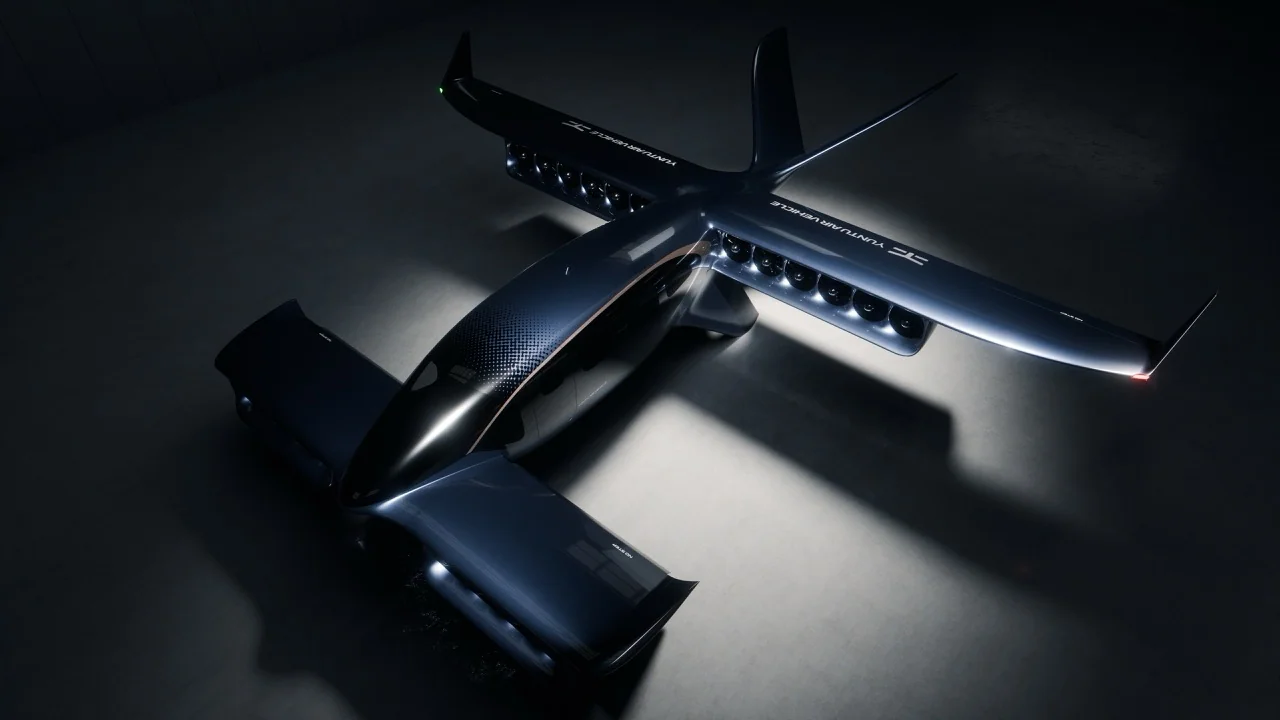
4. Case Study: Retrofitting a 500kg Emergency Medical eVTOL for Hospital Rooftop Operations
Flight Test Retrofit: Securing Vertiport Approval at a Metropolitan Tertiary Hospital
Scenario: An aerospace OEM developed a 500kg MTOW quad-rotor eVTOL for rapid organ transport and medical evacuation, designed to land on an urban hospital rooftop vertiport. Operating 4x 42-inch open carbon propellers, initial hover trials recorded piercing 68 dBA noise inside patient recovery rooms, prompting immediate clinical objections and a complete freeze on flight route certification.
- Phase 1 (Open Propeller Baseline): Hovering at 30 meters altitude, calibrated ground microphones measured 82.4 dBA. FFT spectral decomposition revealed intense pure tones at 280 Hz, 560 Hz, and 840 Hz. Sound penetrated double-glazed ward windows, registering 64.2 dBA indoors with audible structural resonance.
- Phase 2 (YTN-100 Ducted Retrofit): The airframe arms were shortened and refitted with four YTN-100 acoustic-lined ducted thrusters. Vehicle diagonal footprint contracted from 3.2m down to 1.6m, with tip clearance calibrated to 0.7mm.
- Phase 3 (Acoustic Recertification): Hovering under identical atmospheric conditions, sideline sound pressure collapsed to 53.2 dBA—a massive 29.2 dB attenuation! Sharp tonal spikes were completely smoothed into benign broadband pink noise, registering just 41.5 dBA inside hospital rooms.
| Propulsion Architecture | Physical Span / Envelope | Tip Speed (Mach) | Peak Tonal Spike (dBA) | Overall Sound Pressure (dBA) | Human Psychoacoustic Perception | Urban Vertiport Certification |
|---|---|---|---|---|---|---|
| Open Carbon Propeller (42-inch) | 1,067 mm Diameter | 0.62 Mach | 82.4 dBA @ 280 Hz | 85.1 dB(A) | Severe / Penetrating mechanical whine | Failed (Immediate community ban) |
| Standard Unlined Ducted Fan | 480 mm Outer Shroud | 0.48 Mach | 67.1 dBA (High-frequency buzz) | 72.4 dB(A) | Moderate / Noticeable machinery tone | Restricted (Daytime-only operational caps) |
| Yuntu YTN-100 Acoustic-Lined EDF | 420 mm Carbon Shroud | 0.42 Mach | Dispersed (Zero discrete peaks) | 53.2 dB(A) | Benign / Indistinguishable from wind | Fully Certified (Unrestricted 24/7 flight) |
Aeroacoustic Engineering Frequently Asked Questions (FAQ)
Why is 53 dBA considered the non-negotiable threshold for urban vertiport viability?
World Health Organization (WHO) environmental guidelines and municipal zoning laws universally mandate residential daytime ambient noise caps between 55 dBA and 60 dBA. When an arriving or departing eVTOL radiates 53 dBA at 30 meters, psychoacoustic auditory masking conceals the aircraft behind existing traffic and tree rustle, permanently eliminating noise litigation risks.
Does aperiodic blade spacing cause dynamic rotor imbalance or bearing wear over time?
No. Aperiodic spacing is computed via multi-axis dynamic mass balancing algorithms. Opposite blade pairs are mathematically balanced across Cartesian axes, ensuring the principal axis of inertia aligns perfectly with the rotational shaft. Residual dynamic unbalance conforms to aerospace grade ISO 1940 G1.0, and eliminating harmonic resonance actually extends bearing fatigue life by 15%.
Will rain, sand, or environmental debris clog the micro-perforated acoustic liner?
The composite liner incorporates hydrophobic and oleophobic ceramic nano-coatings that prevent liquid and particle adhesion. In flight, high-velocity internal ducted airflow (over 40 m/s) provides continuous aerodynamic self-cleaning. Additionally, subterranean honeycomb cavities integrate passive centrifugal drainage channels to expel moisture immediately.
Can existing open-propeller multirotor drones be retrofitted with ducted fan propulsion?
Yes, provided bus voltage and arm mounting interfaces align. Retrofitting to Yuntu ducted units typically reduces vehicle diagonal wheelbase by 30% to 50%, improves gust stability, and allows operations adjacent to personnel. Yuntu provides customized mounting adapters and digital motor controller matching for direct retrofit integration.