
Electric Air Taxi Propulsion Systems
Architected for next-generation 2 to 7-seat passenger eVTOL air taxis: 53 dBA ultra-quiet urban acoustic compliance, -45% vertiport footprint, FAA 33.19 armored containment, and fail-safe distributed electric propulsion (DEP) redundancy.
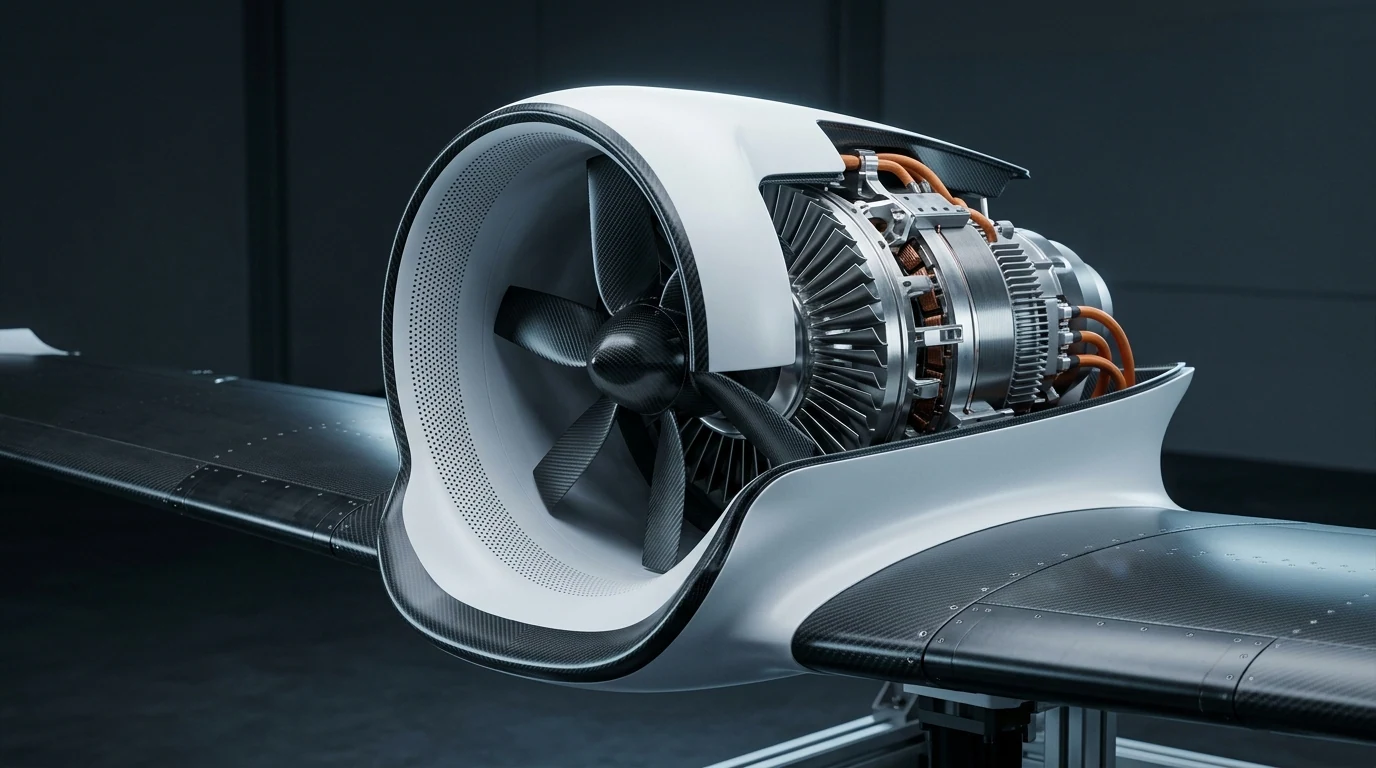
Commercial passenger electric air taxis (2-7 seats) require propulsion systems that resolve three core urban barriers: acoustic compliance below 55 dBA at vertiport perimeters, compact airframe footprints for dense rooftop pads, and mission-critical fail-safe redundancy. Yuntu Aerospace supplies aviation-grade distributed electric ducted fan (DEP) powertrains engineered for passenger eVTOLs. Featuring micro-perforated acoustic treatment (53 dBA @ 100m), 45% footprint reduction versus open rotors, carbon/Kevlar FAA 33.19 blade containment, and N-2 powertrain redundancy, our systems accelerate passenger type certification and commercial entry into service.
100m Sideline Noise Comparative Scale
Acoustic footprint evaluation across propulsion architectures aligned with EASA SC-VTOL and FAA Part 36.
Normal daytime urban background baseline
Acoustic liner cuts 18 dB for unrestricted downtown vertiport clearance
Harsh blade-vortex slap triggering municipal noise bans
Solving the Three Critical Dilemmas in Passenger Air Taxi Operations
Moving from test demonstrators to commercial revenue flights in dense metropolitan centers requires solving regulatory acoustics, vertiport land constraints, and passenger-grade rotor containment safety.
Urban Vertiport Acoustic Clearance
Open-rotor air taxis produce sharp blade-vortex interaction (BVI) harmonics and blade-passage frequencies peaking at 75–85 dBA. This triggers municipal noise vetoes and blocks low-altitude downtown airspace access.
Yuntu micro-perforated acoustic liners (MPL) integrated into the duct shroud absorb high-frequency blade tips, suppressing sideline noise down to 53 dBA at 100m—well below ambient urban street levels.
Vertiport Real Estate & Rooftop Density
Large open-rotor diameters necessitate excessive rotor-tip-to-obstacle margins (FAA AC 150/5390), expanding vertiport touchdown and lift-off (TLOF) diameters by over 40% and inflating rooftop real estate Capex.
High-disk-loading ducted thrusters compact propulsion arrays into wing roots and fuselage nacelles, slashing overall aircraft wingspan/rotor diameter by 45% while safeguarding ground crews from open blades.
Catastrophic Blade Release & OEI Redundancy
A single uncontained blade failure on an open rotor risks puncturing the passenger cabin or severing primary fly-by-wire linkages, making catastrophic failure rates (< 10⁻⁹ / fh) nearly impossible to certify.
Integrated carbon/Kevlar hybrid containment shrouds absorb 100% kinetic energy of liberated fan blades per FAA 33.19. Multi-fan DEP architecture guarantees graceful hover recovery under One Engine Inoperative (OEI).
Scalable Propulsion Matching Across 2 to 7+ Passenger Configurations
Standardized modular ducted thrusters configured in distributed arrays for urban short-hop shuttles, regional commuter aircraft, and high-capacity vertiport fleet operations.
| Parameter / Class | Urban Point-to-Point Shuttle / Aerial Pilot Training 2-Seat Light Commuter 360 – 1,200 kgf Total Thrust | Mainstream Commercial Passenger Air Taxi (Airport Shuttle & Commuter)CORE 4 to 6-Seat Core Air Taxi 1,600 – 4,000 kgf Total Thrust | Intercity High-Density Commuter / Aeromedical Evacuation 7+ Seat Regional Air Mobility 4,000 – 10,000+ kgf Total Thrust |
|---|---|---|---|
| Powertrain Layout | Distributed 6 to 8-Fan Array (YTF-60 / YTF-200) | Distributed 8 to 16-Fan Array (YTF-200 / YTF-500) | Megawatt-Class Distributed Ducted Array (YTF-500 / YTF-1000) |
| Power Bus Voltage | 400V – 600V DC Architecture | 800V DC High-Voltage Isolated Bus | 800V – 1000V DC Dual Redundant Ring Bus |
| OEI Redundancy Margin | Safe Hover & Controlled Landing with 2 Inoperative Fans | Full Mission Continuation or Safe Divert with Dual Propulsion Failures | Category A Transport-Category Equivalent Engine Isolation |
| Flight Profile | 15 – 35 km Urban Transit @ 130 km/h | 50 – 120 km Regional Cross-City @ 220 km/h | 100 – 250 km Intercity Links @ 300 km/h |
| Acoustic Target | <50 dBA Ground Footprint | 53 dBA @ 100m Sideline | <55 dBA Vertiport Boundary |
| Coupled Thrusters |
Aviation-Grade Engineering Standards Built for Type Certification
Every electric ducted fan module is engineered to satisfy the rigorous airworthiness expectations of FAA Part 21.17(b) and EASA SC-VTOL for commercial passenger flight.
Acoustic Liner Attenuation
Helmholtz acoustic resonance chambers tuned specifically to rotor blade passage frequency (BPF) dampen primary tones by 18–22 dB, eliminating siren effects in urban street canyons.
Armor Shroud Blade Containment
Full compliance with FAA 33.19 containment mandates. Multi-layer aramid composite casing arrests fan blade projectiles at 120% maximum overspeed, protecting passengers and cabin pressure.
800V SiC Aviation Inverters
Direct-drive axial/radial flux permanent magnet synchronous motors (PMSM) paired with 800V silicon-carbide (SiC) inverters deliver 98.2% electrical efficiency with high altitude anti-corona insulation.
Distributed DEP Aerodynamic Synergy
Mounting compact ducted thrusters over wing surfaces induces accelerated boundary layer flow, tripling wing lift coefficients (CL) at low takeoff speeds and reducing cruise drag.
Passenger eVTOL Air Taxi Powertrain Integration Whitepaper
Access the comprehensive technical document covering DEP array sizing, OEI thrust allocation algorithms, 800V DC bus weight trade-offs, and urban acoustic certification test logs.
Key Technical Queries on Electric Air Taxi Powertrains
Authoritative insights into air taxi propulsion selection, vertiport acoustic regulations, and passenger safety compliance.