
What happened in Changsha and Yiyang?
Local reporters called the aircraft a “wingless flying car.” Yuntu compiled this account of the third-party project from two reports in Hunan, China.
- November 21 · Changsha. The prototype took off and landed at Kaihui General Airport on its maiden flight. Changsha Evening News (opens in a new tab) reported the flight the following afternoon, when tests at the next site were still listed as upcoming.
- November 22 · Yiyang. Rednet’s evening report (opens in a new tab) confirmed that the prototype completed several flight test tasks. It did not list the individual maneuvers, the altitude reached or who, if anyone, was on board.
Changsha and Yiyang were separate test sites. Changsha Evening News says the prototype moved to Yiyang but does not say how it got there. The distance between the cities therefore tells us nothing about the distance flown.
Which figures describe the aircraft that flew?
The 280 kg limit applies to the single-seater with its payload on board. Adding the 120 kg payload allowance to that figure would count the payload twice. Rednet’s account of the developer’s specifications (opens in a new tab) assigns the much larger 5.5-tonne figure to a separate design.
| Reported figure | Aircraft | What the sources establish |
|---|---|---|
| 280 kg maximum takeoff mass; 120 kg payload | Single-seat prototype | Developer specifications. The reports give no takeoff mass or payload for either flight. |
| About 300 km range; 3,000 m maximum altitude | Single-seat prototype | Published performance figures. Neither outlet reports that the aircraft reached either figure during the tests. |
| 150 km/h maximum airspeed; 80 km/h maximum ground driving speed | Single-seat prototype | Figures for two modes of travel. The reports provide neither a flight speed trace nor a road test record. |
| 2.5 hours maximum endurance; 100 m normal operating altitude | Single-seat prototype | Figures reported by Rednet. The duration and flight profile of each trial remain undisclosed. |
| 5.5 tonnes maximum takeoff mass; 2 tonnes payload | Separate, larger design | The developer said it had completed the technical design. Both flight reports concern the smaller aircraft. |
How far can the prototype fly with its full payload?
The published figures leave that question open. To apply a range figure to a 120 kg payload, a reader would need the load carried for that figure, the cruise speed and the time spent taking off, hovering and landing. Neither report supplies those conditions.
Multiplying maximum airspeed by maximum endurance assumes the aircraft can hold top speed for the entire endurance run. The sources give no basis for that assumption. A dated flight track, takeoff and landing times, and the payload on that flight would allow a reader to assess a specific range demonstration.
How does a vectored ducted fan produce lift?
A duct surrounds the fan blades and guides the air they accelerate. Directing that air downward produces an upward reaction force on the aircraft. Changing the direction of thrust changes its vertical component and can also produce a turning moment to control the aircraft’s attitude.
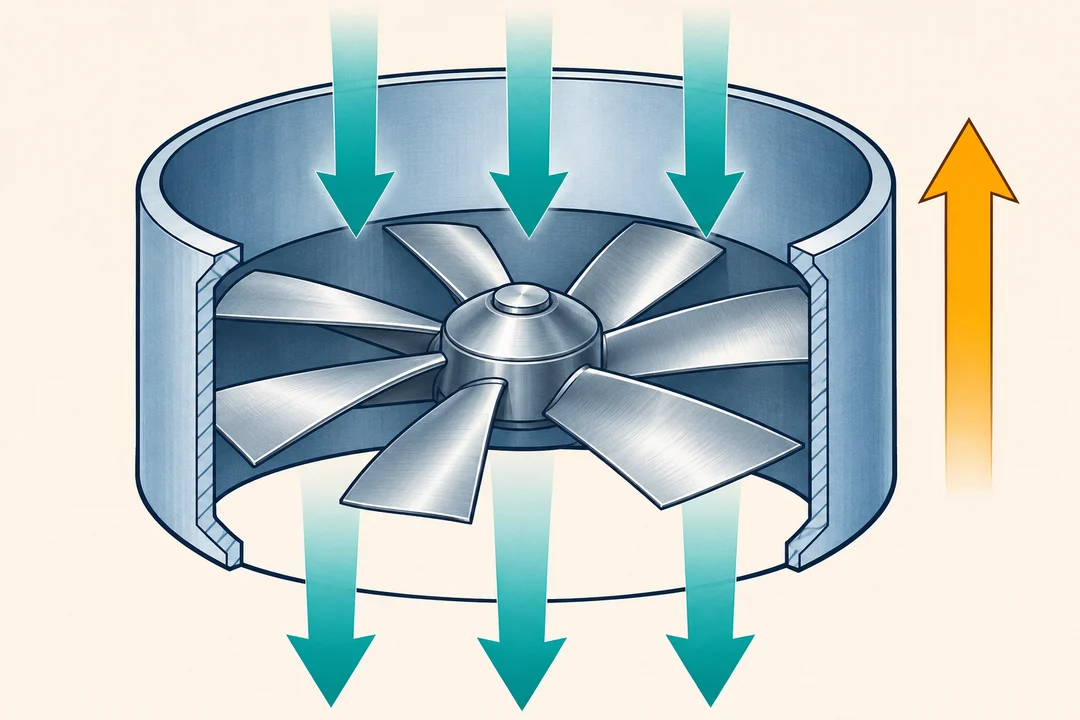
Both outlets describe enclosed, multistage vectored fans. Neither specifies the power source, the internal arrangement of the stages or the mechanism that redirects thrust. For a separately documented aircraft, see our account of the CE-25A’s first crewed flight, or explore electric ducted fan propulsion, passenger drone architectures, and our 2026 flying cars status.
An enclosed fan explains why no rotor blades are visible from outside. It does not reveal what powers the aircraft or how loud it is. To assess the developer’s claims about noise and cruise energy use, a comparison would need to identify the other aircraft, their loads and speeds, and the distance to the microphone. The reports give no such comparison data.
What would show that the prototype is closer to sale?
What is planned for Changsha and future models?
In an interview published by Hunan Online on November 24, Zhongfei technical director Yang Yang said the team plans to test 10 to 20 prototypes of different types in Changsha once the pilot testing facility is operational. The developer is targeting a two- to four-seat version in 2027 and a six-seat version and heavy-payload variant in 2029. The interview did not establish production, certification, sales or delivery dates. Source: Hunan Online interview (Chinese) (opens in a new tab)
Rednet (opens in a new tab) places the project in pre-production validation and describes certification and production preparation as future work. Driving on the ground is one of the vehicle’s reported capabilities. Public-road access and commercial passenger service are separate questions, each requiring evidence of permission for that use.
- For a certification announcement, check which aircraft and activity the approval covers. A document for the larger design would tell us little about the status of the single-seater.
- For a sales announcement, look for a specific model, published terms, an ordering channel and delivery conditions from the developer. Plans for a production facility establish none of those details.
Developer, range, sales and certification
Who built the wingless flying car?
Rednet identifies the developer as 中飞创智制造(深圳)有限公司, rendered here as Zhongfei Chuangzhi Manufacturing (Shenzhen). Yuntu is covering the project as an outside publisher.
Did the Changsha prototype actually fly 300 km?
The public reports do not show that it did. They give a published range figure, but no flight track or measured distance for either test. The reports do not say how the prototype was transported to Yiyang.
How much does the wingless flying car cost, and can I buy it?
The sources reviewed do not give an official price, sales date or order channel. Announced development milestones for future versions are not delivery commitments. Yuntu does not take orders or provide quotes for this prototype.
Does a successful flight test mean the aircraft is certified?
No. The reports do not provide an airworthiness certificate, a commercial passenger operations approval or a public-road authorization for this prototype.
Integrating ducted propulsion into your aircraft?
Tell our engineers about your own project. Yuntu does not quote or take orders for the Changsha prototype.
Discuss my ducted propulsion projectSources and verification date
Published on November 23, 2026; updated and verified on November 24, 2026. Changsha Evening News (opens in a new tab) documented the maiden flight. Rednet (opens in a new tab) confirmed the Yiyang tests and attributed the aircraft specifications to the developer. Hunan Online (opens in a new tab) published the November 24 interview detailing Changsha pilot-testing and future-model plans. All three sources are in Chinese.